
You can easily create a daily planner for your preschool program. Scheduling and planning help your school day run more smoothly so you can focus your time on engaging with the kids.
Privacy Policy for information on use of cookies and affiliate links
A daily planner has value for early learning program by keeping you organized and prepared, which in turn reduces stress. The daily planner is an important asset to have in your toolkit when developing, or fine tuning, your early learning program.
Whether you’re a teacher in a licensed child care center or a parent homeschooling a preschooler, you can benefit from the preparedness that comes with maintaining a daily planner.
At home or in the classroom, being organized and prepared results in less stress for you, and more time to engage and interact with the children.
This is the third post in a four-part series: Developing an Early Learning Program.
This post discusses the value of a daily planner, and shares ideas for planners to use at home or in the classroom.
Related: Follow along with Teaching Mama blog as a daily planner is filled in for the week ahead.
Value of a daily planner for a preschool program
What is a daily planner?
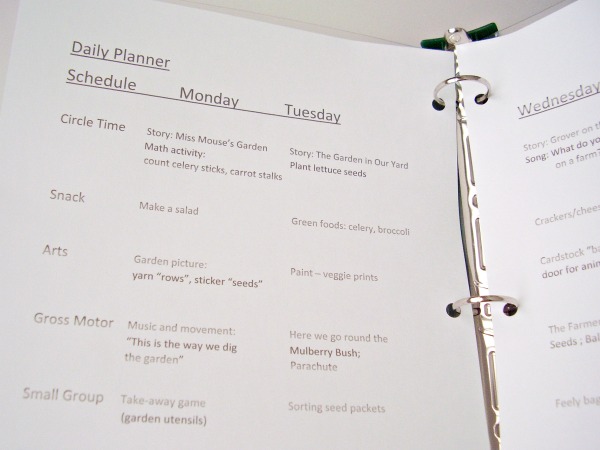
A daily planner records the activities teachers and homeschooling parents prepare to support the curriculum. The planner lists the songs you sing at circle time, the games played during gross motor time, and the project introduced at arts and crafts time.
What is the benefit of a daily planner?
A daily planner has many benefits for your early learning program. By outlining the activities and documenting engagement and outcomes, teachers and parents share in the understanding of developing skills.
- The planner connects parents and guardian to the child care facility.
Parents can read up on the events and activities in which their children are engaged day-to-day. Some centers also provide an online service to families, where posts related to school activities and events are shared. - Documentation ensures information is available for review.
Were the children engaged? What was accomplished? What developmental skills were engaged – including cognitive, social, emotional, language, fine motor, gross motor.? - Activities can be planned in advance.
Advance planning allows teachers to gather materials, book field trips, contact parents or guardians, prepare . - A daily planner anticipates spontaneous learning opportunities.
Alternate activities can be included in the planner to support or replace the planned activities. Will the weather alter our plans? Is the activity frustrating or difficult? Are the children engaged in another topic that we can pursue instead of the planned activity?
A program planner works in conjunction with the daily schedule which provides time slots throughout the day for each activity. Teachers can be flexible with both the schedule and the planned activities as needed. There is always the option to extend an activity that is fun and engaging, or cut short an activity that is unproductive. The goal is to engage the children in hands-on experiences while having lots of fun!
Here are the links for the posts included in this four-part series:
Part 1: Determining the Basic Principles of your Early Learning Program
Part 2: Establishing a Daily Schedule for Your Early Learning Program
Part 3: Why There is Value in a Daily Planner for Your Early Learning Program (you are here)
Part 4: Planning Quality Content for Your Early Learning Program
Program planners from other kid-friendly bloggers:
Mom Inspired Life shows how to set up planners using sticky notes.
Hands On As We Grow schedules weekly activities with toddlers or preschoolers.
Childhood 101 shares a home family planner.